Annual Reports
Pfizer Inc.'s annual reports contain management's most considered account of the business. These are the sections, passages and visual pages worth opening in the originals preserved in Sources.
Pfizer Inc. — FY2025 Annual Report (Form 10-K) — FY2025
The latest 10-K: how Pfizer is organized, the patent-cliff it must out-run, the 2025 results, and the landmark U.S. drug-pricing deal. · Open the full document →
Item 1. Business — p. 18 · Read the full section →
Defines what Pfizer is and how it is run — three operating segments, of which only Biopharma is reportable.
Commercial structure: three operating segments, Biopharma the only reportable one.
We manage our commercial operations through a global structure consisting of three operating segments, each led by a single manager: Biopharma, PC1 and Pfizer Ignite. Biopharma, our innovative science-based biopharmaceutical business, is engaged in the discovery, development, manufacture, marketing, sale and distribution of biopharmaceutical products worldwide. PC1 is our contract development and manufacturing organization and a leading supplier of specialty active pharmaceutical ingredients. […] Biopharma is the only reportable segment.
p. 20 · Read in context →
Item 1. Business — Patents and Other Intellectual Property Rights — p. 25 · Read the full section →
The loss-of-exclusivity dynamic that governs pharma revenue, with management's own map of when key patents expire.
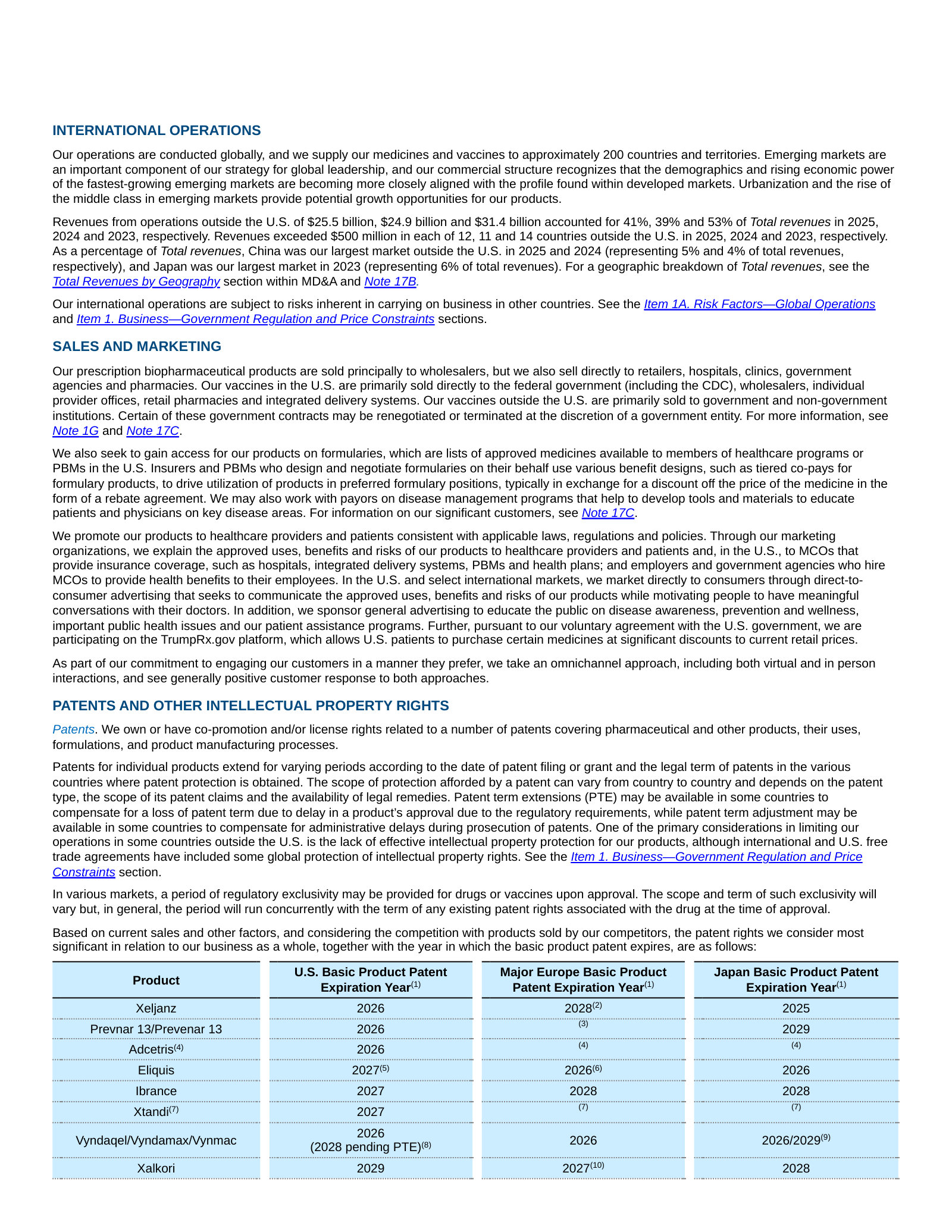
Management's warning of accelerating revenue loss from patent expiries, 2026–2030.
Once patent protection has expired or has been lost prior to the expiration date as a result of a legal challenge, we typically lose market exclusivity on these products, and generic and biosimilar pharmaceutical manufacturers generally produce identical or highly similar products and sell them for a lower price. […] We anticipate a significant reduction of revenue from patent-based or regulatory exclusivity expiries in 2026 through 2030 as several of our in-line products experience these expirations, with the rate of the reduction of revenues from patent-based or regulatory exclusivity expiries expected to significantly accelerate over the next few years.
p. 29 · Read in context →
Item 1A. Risk Factors — p. 43 · Read the full section →
The company-specific risks that could genuinely bite: revenue concentration in a dozen products and payer/policy pricing pressure.
Concentration: 12 products were 65% of revenue in 2025; Eliquis alone 13%.
We recorded revenues of more than $1 billion for each of 12 products that collectively accounted for 65% of Total revenues in 2025. For example, Eliquis accounted for 13% of Total revenues in 2025.
p. 45 · Read in context →
Pricing pressure from consolidating payers and the Inflation Reduction Act.
As the U.S. third-party payor market consolidates further, and as the IRA prices become publicly available, we may face greater pricing pressure from third-party payors, including insurers and PBMs, as they continue to drive more of their patients to use lower cost alternatives or seek even larger rebates to control costs or offset losses from the IRA and other market pressures.
p. 43 · Read in context →
Item 7. Management's Discussion and Analysis — p. 70 · Read the full section →
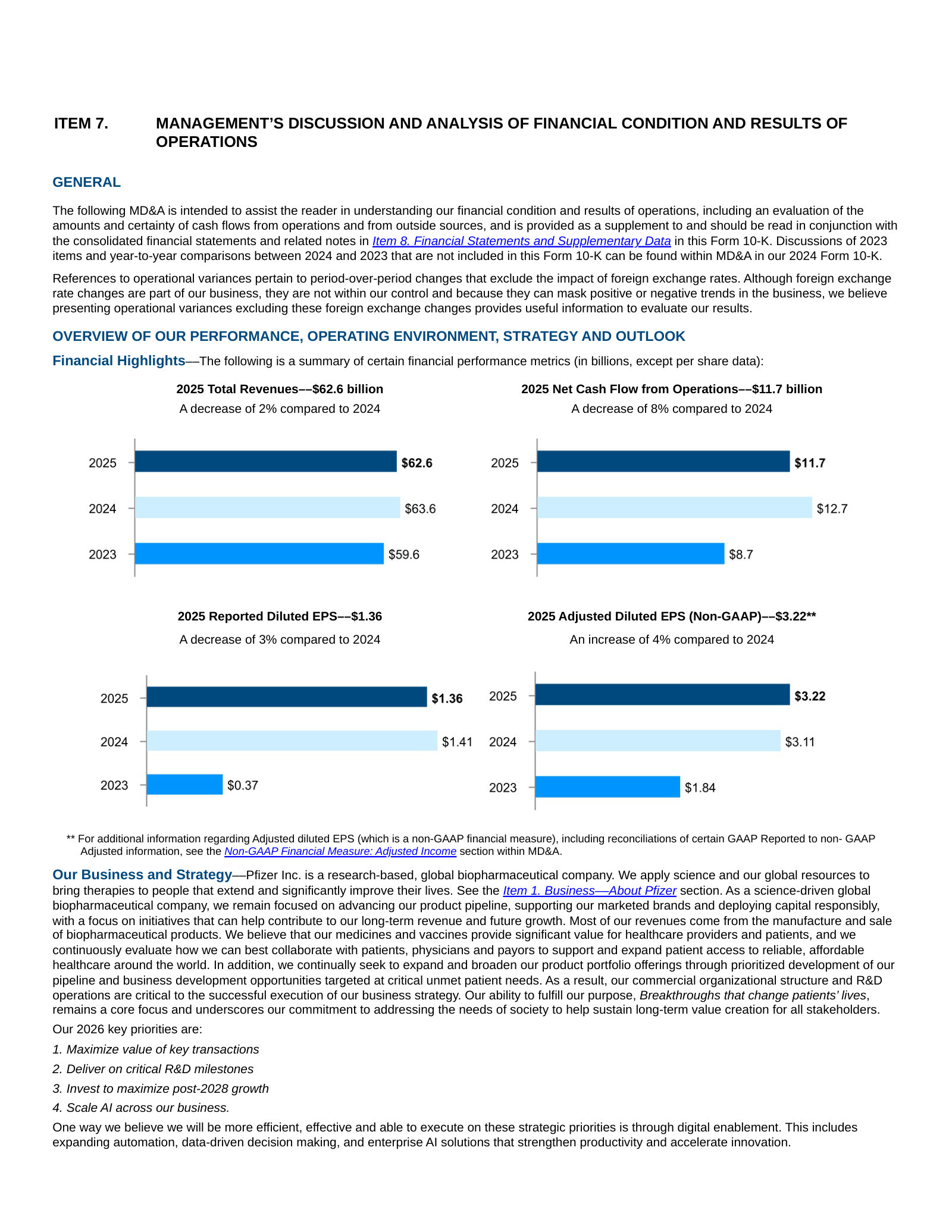
Management's own account of 2025: revenue down 2%, plus the year's biggest strategic event — the U.S. government drug-pricing agreement.
Item 7. MD&A — Product Developments — p. 90 · Read the full section →
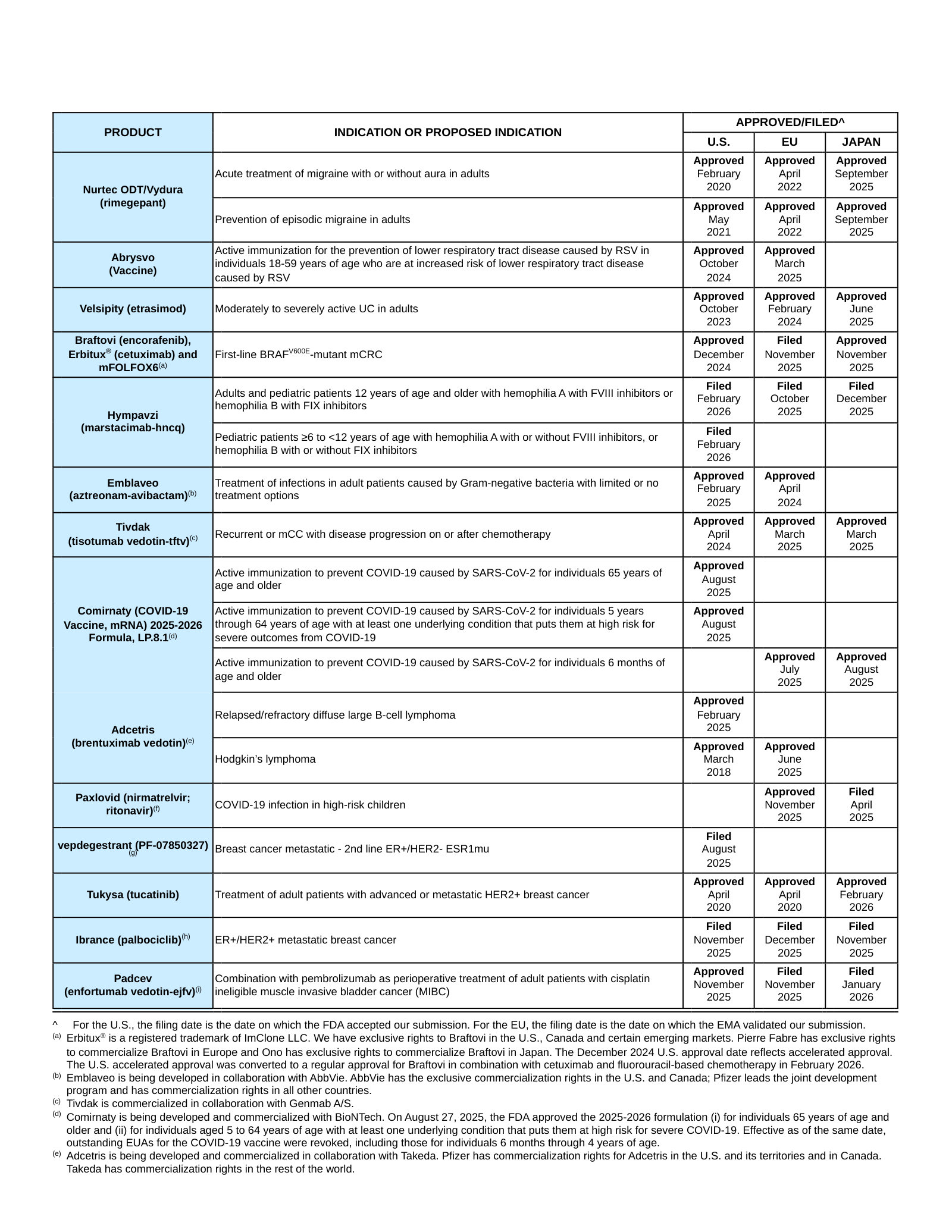
The pipeline replenishment that must offset the patent cliff — recent approvals and filings across the U.S., EU and Japan.
Note 17. Segment, Geographic and Other Revenue Information — p. 191 · Read the full section →
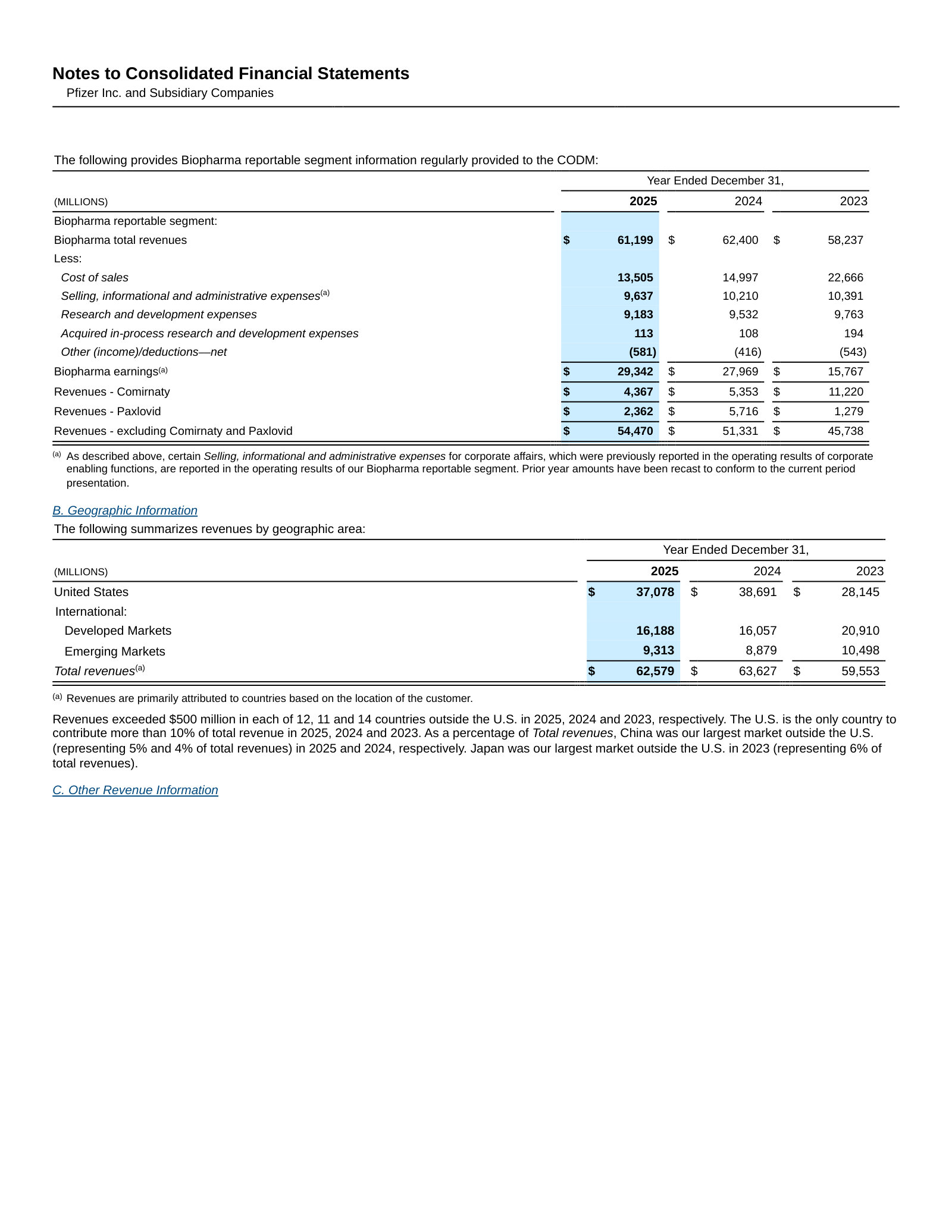
How Pfizer makes money: Biopharma segment economics, revenue ex-COVID (+6% underlying), and the geographic split.
More annual reports
Pfizer Inc. — FY2024 Annual Report (Form 10-K) — FY2024 · 213 pages · Prior year: the first full year absorbing the COVID-product decline and integrating the Seagen oncology acquisition. · Open →
Pfizer Inc. — FY2023 Annual Report (Form 10-K) — FY2023 · 218 pages · The transition year: COVID revenues collapse, large inventory write-offs, and the $43B Seagen deal close. · Open →
Pfizer Inc. — FY2022 Annual Report (Form 10-K) — FY2022 · 144 pages · Peak-COVID year — record revenue from Comirnaty and Paxlovid — the baseline the later declines are measured against. · Open →
Pfizer Inc. — FY2021 Annual Report (Form 10-K) — FY2021 · 166 pages · The Comirnaty launch year that doubled revenue — the start of the COVID-era earnings bulge. · Open →